Introduction
Mobile devices have become an essential tool in people’s daily lives; they are used to perform multiple tasks, including those related to the healthcare sector. Mobile Cloud Computing (MCC) and Big Data technologies are transforming this field. However, these devices have limitations in terms of processing power and memory. To overcome these constraints, mobile cloud computing emerges, integrating mobile devices with cloud infrastructure, which is responsible for data storage and processing.[2]
Cloud Computing and Big Data
· Cloud computing allows access to computing resources over the internet, on demand and with low management cost. This technology enables access to information from anywhere at any time, improving productivity and reducing system complexity.[2]
· Big Data is characterized by the four Vs:
- Volume: large amounts of data
- Variety: different types of data
- Veracity: reliability
- Velocity
These technologies make it possible to extract useful information from large volumes of data.
Networked Healthcare
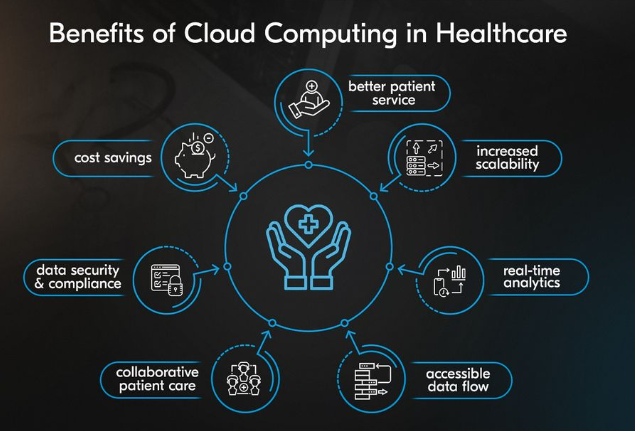
In the healthcare field, this integration leads to what is known as networked healthcare. In this model, medical data is collected in real time through patients’ mobile devices and sent directly to the cloud, where it is stored and analyzed, enabling faster decision-making.
This model allows healthcare professionals to access advanced analytical tools and decision-support systems directly from mobile devices at the point of care. This makes it easier for doctors to combine data from multiple sources and make faster, more informed, and context-aware decisions.[2]
It is considered essential that Electronic Health Records (EHR), Personal Health Records (PHR), and Health Information Exchange (HIE) systems become the technological foundation of modern healthcare systems. Thanks to this model, costs, medical errors, and organizational inefficiencies are reduced.[3]
Applications and Technical Evolution
There are already various applications available, such as HealthKit, which centralizes health and fitness data from iPhone and Apple Watch devices, allowing third-party apps to share information securely and with user authorization. Other applications are capable of receiving patient data through wireless sensor networks, enabling the collection of physiological parameters from multiple patients using sensors attached to the body.[1]
The rapid expansion of mobile applications and the massive amount of data they generate has highlighted the need for more advanced mobile cloud computing models. Cloudlets address this need by allowing applications to run faster and more efficiently. These are small processing centers located close to the user, positioned between the mobile device and the central cloud, reducing latency and energy consumption.
However, cloud computing also presents major challenges, particularly in terms of security and privacy, especially when dealing with sensitive medical data.
Summary
| Technology | Function | Benefit |
|---|---|---|
| Mobile devices | Collect patient data in real time | Continuous monitoring |
| Cloud computing | Store and process information | Remote access |
| Big Data | Analyze large volumes of data | Better decision-making |
| Cloudlets | Reduce latency and energy consumption | Faster and more efficient responses |
| HealthKit | Centralize health data | Integration of healthcare information |
Conclusion
In conclusion, networked healthcare can leverage mobile cloud computing and Big Data analytics to manage large volumes of clinical information efficiently and in real time. These technologies are revolutionizing biomedicine, although important challenges such as data security and privacy still need to be addressed.
References
[1] HealthKit. https://developer.apple.com/documentation/healthkit
[2] Cloud computing in Healthcare. https://ieeexplore.ieee.org/abstract/document/7576619
[3] Mobile Cloud Computing Model and Big Data Analysis for Healthcare Applications. https://acropolium.com/blog/cloud-computing-healthcare/